Let’s Talk Dollhouse Scale

What Is Dollhouse Scale?
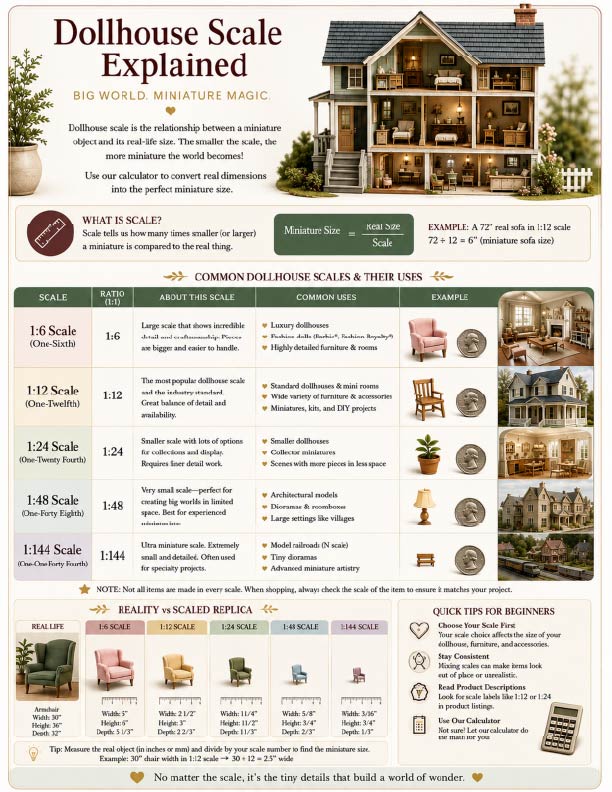
Scale is the ratio between a real-life object and its miniature version. For example, a 1:12 scale means that one inch in the miniature world equals twelve inches (one foot) in real life. If a real dining table is 72 inches long, the same table would be 6 inches long in a 1:12 scale dollhouse.
The larger the second number in the ratio, the smaller the miniature becomes. A 1:48 scale item is much smaller than the same item in 1:12 scale because it represents a greater reduction from the original size.
Choosing the correct scale is important because furniture, accessories, dolls, and architectural details are all designed to work together within the same scale. Mixing scales can make a room look unrealistic unless the size differences are intentional.
Why Scale Matters
Imagine placing a 1:6 scale armchair inside a 1:24 scale dollhouse. The chair would appear enormous and completely out of proportion. Likewise, placing a 1:48 scale lamp in a 1:12 scale room would make it look tiny and unrealistic.
Using a consistent scale throughout your project helps create the illusion that viewers are looking at a real room, home, or scene that has simply been shrunk down.
Our scale calculator makes these conversions simple by automatically converting real-world measurements into miniature dimensions for your chosen scale.
The Most Common Dollhouse Scales
1:12 Scale (One Inch Scale)
The 1:12 scale is the most popular dollhouse scale in the world and is often considered the industry standard. In this scale, one inch equals one foot in real life. Because of its popularity, it offers the widest selection of dollhouses, furniture kits, accessories, dolls, and building supplies.
This scale is ideal for beginners because it provides an excellent balance between detail and size. Furniture is large enough to build comfortably while still allowing an entire house to fit on a shelf or tabletop.
Example
Real Sofa Length: 72 inches (6 feet)
1:12 Scale Sofa Length: 6 inches
A standard interior door measuring 80 inches tall in real life would be approximately 6.67 inches tall in a 1:12 scale dollhouse.
1:6 Scale (Playscale or Fashion Doll Scale)
The 1:6 scale is twice as large as 1:12 scale and is commonly used for fashion dolls. Because the pieces are larger, builders can include incredible detail and realistic craftsmanship.
This scale is perfect for creating highly detailed room boxes, luxury dollhouses, and display pieces. Furniture is easier to construct and customize because of its larger size.
Example
Real Armchair Width: 36 inches
1:6 Scale Armchair Width: 6 inches
A real kitchen countertop that is 24 inches deep would be 4 inches deep in 1:6 scale.
1:24 Scale (Half Scale)
The 1:24 scale is commonly referred to as "half scale" because it is half the size of a 1:12 scale miniature. This scale allows builders to create larger houses or more rooms while using less display space.
Collectors often choose 1:24 scale when they want to build detailed scenes without dedicating an entire room to their collection.
Example
Real Dining Table Length: 72 inches
1:24 Scale Dining Table Length: 3 inches
A real six-foot bookcase would be only 3 inches tall in this scale.
1:48 Scale (Quarter Scale)
The 1:48 scale is often called quarter scale because it is one-quarter the size of standard 1:12 miniatures. It is a favorite among collectors who enjoy creating entire villages, streetscapes, and large architectural displays in limited space.
Although the miniatures are very small, modern manufacturing techniques allow for impressive levels of detail.
Example
Real Dining Table Length: 72 inches
1:24 Scale Dining Table Length: 3 inches
A real six-foot bookcase would be only 3 inches tall in this scale.
1:48 Scale (Quarter Scale)
The 1:48 scale is often called quarter scale because it is one-quarter the size of standard 1:12 miniatures. It is a favorite among collectors who enjoy creating entire villages, street-scapes, and large architectural displays in limited space.
Although the miniatures are very small, modern manufacturing techniques allow for impressive levels of detail.
Example
Real Chair Height: 36 inches
1:48 Scale Chair Height: ¾ inch
A real eight-foot ceiling would measure only 2 inches tall in a 1:48 scale room.
1:144 Scale (Micro Scale)
The 1:144 scale is often called micro scale and is one of the smallest scales used in dollhouse miniatures. Entire houses can fit into the palm of your hand, making this scale perfect for collectors with limited display space.
Creating miniatures at this size requires patience and advanced crafting skills because even small details become incredibly tiny.
Example
Real Dining Chair Height: 36 inches
1:144 Scale Chair Height: ¼ inch
A complete three-story Victorian home may stand only a few inches tall in this scale.
Reality vs. Miniature Scale
One of the easiest ways to understand scale is to compare a real object to its miniature versions.
Imagine a real armchair measuring:
- Width: 30 inches
- Height: 36 inches
- Depth: 32 inches
The same chair would measure approximately:
1:6 Scale
- Width: 5 inches
- Height: 6 inches
- Depth: 5⅓ inches
1:12 Scale
- Width: 2½ inches
- Height: 3 inches
- Depth: 2⅔ inches
1:24 Scale
- Width: 1¼ inches
- Height: 1½ inches
- Depth: 1⅓ inches
1:48 Scale
- Width: ⅝ inch
- Height: ¾ inch
- Depth: ⅔ inch
1:144 Scale
- Width: 3⁄16 inch
- Height: ¼ inch
- Depth: ¼ inch
Seeing the same object represented across different scales quickly demonstrates how dramatically the size changes while the proportions remain the same.

Final Thoughts
If you're new to dollhouses and miniatures, start with 1:12 scale whenever possible. It offers the largest selection of products, the most tutorials, and the easiest building experience for beginners.
- Choose 1:6 scale if you enjoy highly detailed projects and have plenty of display space.
- Choose 1:24 scale if you want to create larger homes without needing large display areas.
- Choose 1:48 scale if you enjoy collecting architectural miniatures or building villages and streetscapes.
- Choose 1:144 scale if you love tiny details and advanced miniature craftsmanship.
DOWNLOAD Our Free Scale Infographic