
Let’s Talk 3D Printers & Lasers
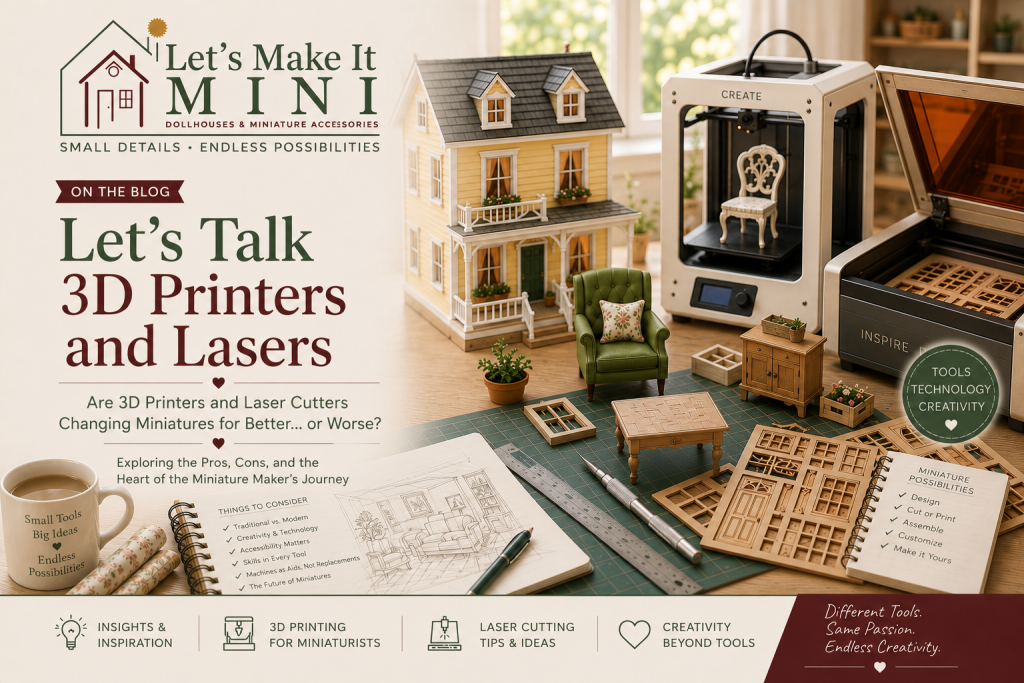
Are 3D Printers and Laser Cutters Changing Miniatures for Better… or Worse?
Few topics spark more passionate conversations in the miniature community than technology. Mention laser cutters or 3D printers in an online dollhouse group, and you'll likely see two very different reactions. One person celebrates the incredible detail now possible, while another insists that "real" miniatures should be made entirely by hand.
Who's right? Perhaps...both.
As with many creative hobbies, the answer isn't as simple as choosing one side over the other. Technology has changed nearly every artistic discipline. Photography didn't eliminate painting. Digital illustration didn't replace watercolor. Sewing machines didn't end quilting. Instead, artists found new ways to create.
Miniatures are no different. Today, laser cutters, CNC machines, resin printers, filament printers, and digital design software are becoming common tools in workshops around the world. For some creators, they're exciting opportunities. For others, they represent the loss of traditional craftsmanship. So let's explore both sides of the debate.
"The question isn't whether technology belongs in miniature making. The real question is how we choose to use it."
The Traditionalist's View
Many miniature artisans have spent decades perfecting their skills. They learned how to measure by eye, hand-cut every board, carved moldings with knives and chisels, and sanded every edge by hand. Every tiny mistake became a lesson, and every finished piece represented hours—or even days—of patient craftsmanship.
To many of these makers, that's the very soul of miniature building. Their concern isn't really about the machines. It's about what could be lost.
Traditional builders often worry that technology encourages shortcuts. If a computer draws every line, a laser cuts every piece, or a printer produces an entire chair overnight, where is the craftsmanship? Where is the skill? Where is the satisfaction of mastering techniques that have been passed from one generation of miniaturists to the next?
These concerns deserve respect. There is something deeply rewarding about transforming a simple sheet of basswood into an elegant cabinet using nothing more than patience, sharp tools, and experience. That knowledge shouldn't disappear.
The Modern Maker's View
Now let's look through another window.
Imagine someone discovering miniatures today. Instead of a workshop full of saws and carving tools, they own a desktop laser cutter or perhaps a small resin printer. They spend hours designing furniture in CAD software before carefully assembling, finishing, and painting every piece.
Are they any less creative? Most would say no.
In fact, many modern makers spend countless hours learning digital design, tolerances, engineering, printing techniques, finishing methods, painting, weathering, and assembly. The machine may cut the pieces, but the creator still designed them, solved the problems, and brought the idea into existence.
Technology hasn't replaced creativity. It has simply changed where that creativity happens.
When Technology Becomes an Equalizer
This is where the conversation becomes deeply personal.
I live with arthritis in my hands. Years ago, cutting dozens—or even hundreds—of tiny wooden pieces wasn't a problem. Today, it's different. Holding a hobby knife for long periods causes pain, and repeated cutting can leave my hands stiff for days. Even something as simple as carving window trim can become physically exhausting.
Should that mean my creative journey is over? I don't believe so. A laser cutter can prepare the pieces. A 3D printer can create the difficult shapes. But neither one builds the project.
I still have to:
- Sand
- Paint
- Test fit
- Glue
- Adjust
- Weather
- Decorate
- Solve problems
- Make design choices
Machines don't decide color palettes. They don't create cozy rooms, arrange furniture, or add personality. The creativity still belongs to the maker.
The tools simply make it possible for someone like me to keep creating.
And I know I'm not alone.
Many miniature enthusiasts live with arthritis, tremors, limited vision, chronic pain, nerve damage, or other physical challenges. Technology doesn't diminish their creativity. It gives them access.
Is Using a Laser Cutter "Cheating"?
This question appears often, and the answer depends on what you believe the goal of the hobby should be.
If the purpose is mastering traditional woodworking techniques, then yes—a laser cutter removes part of that challenge. But if the purpose is creating beautiful miniatures...Does it matter?
Consider these examples.
- Few people mill their own lumber before building a dollhouse. Most buy basswood. Is that cheating?
- Few people forge their own saw blades. Most buy tools. Is that cheating?
- Many purchase ready-made hinges, doorknobs, windows, lighting fixtures, or wallpaper. Is that cheating?
Where do we draw the line? Every hobby evolves. Technology simply changes where that line exists.
The Other Side of the Argument
Let's play devil's advocate.
Technology does create new concerns. When someone downloads a free file, presses "Print," and immediately claims to have handcrafted the design, that feels dishonest. Mass-producing printed items can flood marketplaces with nearly identical products. Some sellers never disclose that items are machine-produced, while others copy or redistribute digital designs without permission.
Traditional artisans also worry that younger makers may skip learning foundational skills entirely. Why learn joinery if software creates perfect joints? Why practice carving if a printer can reproduce ornate details?
Those concerns aren't imaginary. They're worth discussing. Technology should enhance craftsmanship—not replace curiosity and learning.
The Hidden Skills Behind Modern Tools
People often underestimate the learning curve. Owning a laser cutter doesn't guarantee beautiful miniatures, and neither does buying a resin printer. Machine users must learn an entirely different set of technical skills before producing quality work.
These skills include:
- Graphic design
- CAD software
- Material properties
- Machine calibration
- Print orientation
- Resin chemistry
- Wood behavior
- Kerf compensation
- Paint adhesion
- Finishing techniques
- Safety procedures
- Troubleshooting
Every new tool introduces its own craft. Different doesn't mean easier. Sometimes it's simply a different set of skills.
The Best Miniatures Blend Both Worlds
Interestingly, many award-winning miniature artists already combine traditional and modern techniques. A laser cuts the structure while hand tools refine the joints. A printer creates ornate hardware that is later painted and weathered by hand. Fabric is sewn traditionally, wood is stained by hand, furniture is distressed with brushes and pigments, and flowers are sculpted individually.
The finished piece becomes something neither machine nor hand could have created alone. That's collaboration. Not replacement.
The Future of Miniatures
Technology isn't going away. Neither is traditional craftsmanship. In fact, the future probably belongs to makers who appreciate both.
- Learn hand skills.
- Understand wood.
- Practice painting.
- Study finishes.
- Experiment with digital tools.
- Use whatever helps bring your imagination to life.
Some projects may be entirely hand-built. Others may begin on a computer. Neither approach makes someone more—or less—creative.
Creativity Can't Be Automated
Here's one thing every side of the debate should agree on.
A machine cannot imagine. It cannot dream. It cannot look at an empty dollhouse and picture a grandmother's kitchen from 1948. It cannot tell a story through tiny objects. It cannot decide where the cat sleeps, where the child left their toy, or which wallpaper reminds someone of their childhood home.
Those decisions belong to the artist. Always.
Finding Common Ground
Perhaps we've been asking the wrong question. Instead of asking: "Did you make that by hand?" Maybe we should ask: "What inspired you to create it?"
Miniatures have always celebrated imagination. Whether your workshop contains carving knives, chisels, laser cutters, or 3D printers, the goal remains the same: to build tiny worlds that bring joy.
If technology helps someone with arthritis continue creating, allows someone with limited mobility to participate in a hobby they love, or introduces a new generation to miniature making, perhaps these machines aren't replacing craftsmanship after all. Perhaps they're simply opening the workshop door to more people. And that's something worth celebrating.
"Creativity has never depended on the tools in our hands. It has always come from the imagination in our hearts."


Final Thoughts
Where do you stand on the debate?
- Do you build everything by hand?
- Do you use laser cutters or 3D printers?
- Do you combine traditional and modern techniques?
- Has technology made the hobby more accessible for you or someone you know?
I'd love to hear your thoughts in the comments. Let's keep the conversation respectful because, at the end of the day, we're all here for the same reason: a love of creating miniature worlds—one tiny detail at a time.

[…] explored the place of technology in our hobby in Let’s Talk 3D Printers & Lasers. AI gives us another set of choices. You might use it often, occasionally, or only to get past a […]