
Small Talk August Feature

Why the World Is Thinking Small Again
There is something wonderful happening in the miniature world.
Dollhouses are being rescued from attics and given new life. Room boxes are appearing on worktables. Book nooks are turning ordinary shelves into tiny streets, libraries, and imaginary worlds. Makers are sharing miniature kitchens, shops, gardens, studios, and wonderfully detailed everyday scenes online.
Miniatures, it seems, are having a big moment.
For those who have loved the hobby for years, this may not feel like a comeback at all. Miniaturists never stopped building, collecting, teaching, and sharing their work. But the hobby is reaching a wider audience again, and many new makers are discovering that miniatures are much more than children’s toys.
They are art, craftsmanship, storytelling, history, design—and a very satisfying way to spend an afternoon.
A creative escape in a busy world
Life can feel noisy and hurried. Miniature making asks us to do something different.
It asks us to slow down and notice.
We study the curve of a chair leg, the pattern on a wallpaper, the way a tiny book rests on a table, or the exact shade of green needed for a miniature front door. A large project can be broken into small, manageable decisions. One wall. One chair. One flowerpot. One tiny picture frame.
That focus can provide a welcome break from screens, schedules, and everyday worries.
Recent coverage of the hobby has connected its renewed popularity with the creative activities people rediscovered while spending more time at home, as well as the visibility miniaturists now receive through Instagram, TikTok, and other online communities. The Washington Post recently reported that social sharing has helped introduce the hobby to a younger generation seeking a creative escape.
Of course, miniature making does not remove the responsibilities waiting outside the craft room. But for a little while, it gives us a world small enough to hold in our hands.
Tiny spaces leave room for big stories
A miniature scene becomes especially interesting when it feels as though someone has just stepped away.
A cup sits beside an open book. A pair of garden boots waits near the door. Fabric is draped over the back of a sewing-room chair. A half-finished pie rests on a kitchen table.
Nothing has to move for the scene to feel alive.
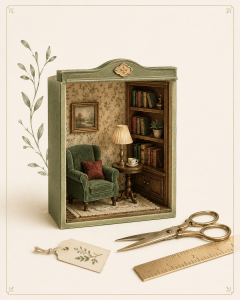
That is one reason room boxes and book nooks appeal to so many new makers. A person does not need the space, time, or budget for an entire dollhouse. One small setting can tell a complete story.
Book nooks have become particularly visible as both craft projects and home décor. These narrow miniature scenes fit between books and combine model making, lighting, storytelling, and display in one approachable project.
A miniature project can also preserve a memory. Makers recreate childhood kitchens, family shops, favorite reading rooms, grandparents’ homes, and places that no longer exist. The result may be tiny, but the meaning behind it can be enormous.
There are more ways to begin
New miniaturists once had to rely primarily on specialty shops, shows, clubs, magazines, and the occasional fortunate discovery at a craft store.
Those resources remain important, but beginners now have many more entry points.
They can start with:
- A dollhouse or room-box kit
- A book nook
- A thrifted dollhouse renovation
- A miniature garden
- Printable wallpaper and flooring
- Polymer-clay food
- A single piece of furniture
- A display beneath a glass dome
- A scene built inside an ordinary box
Laser cutters and 3D printers have also expanded what makers can design and reproduce. Online tutorials make specialized techniques easier to learn, while social groups allow a beginner to ask a question and hear from experienced makers around the world.
The hobby can include affordable kits and recycled materials as easily as it can include finely crafted artisan pieces. Architectural Digest has described the present miniature world as ranging from accessible toys and kits to museum-quality work, with interest crossing ages and creative backgrounds.
There is no single correct entry point to the hobby—and no requirement that every project become a masterpiece.
Tradition is meeting new imagination
The renewed interest in miniatures is not replacing the traditional dollhouse world. It is adding to it.
Classic period rooms, historically accurate furnishings, and heirloom-quality artisan work continue to inspire collectors and builders. At the same time, makers are creating modern apartments, fantasy shops, abandoned buildings, science-fiction scenes, greenhouse studios, and tiny homes that reflect their own lives.
Some makers enjoy exact scale and historical accuracy. Others prefer whimsy, experimentation, or a mixture of scales. Some build every object themselves. Others combine handmade pieces, kits, found objects, purchased miniatures, and printable designs.
All of these approaches can belong in the miniature community.
Established organizations continue to preserve and advance miniature craftsmanship. The International Guild of Miniature Artisans is holding its 2026 Guild Show in New Jersey from August 3–9, including a public Show and Sale on August 8 and 9. Events like this bring together teaching, collecting, craftsmanship, and the friendships that have long supported the hobby.
Social media has opened the tiny front door
Miniature making is particularly well suited to photographs and short videos.
Viewers can watch a plain wooden shell become a finished room. They can see a tiny cake formed from clay, a miniature lamp begin to glow, or an ordinary household object transformed into something suitable for a dollhouse.
These little moments invite curiosity.
Someone who has never considered building a dollhouse may stop to watch a one-minute video. Before long, that person is researching scale, collecting supplies, and clearing a corner of the table for a first project.
Social media can sometimes make a beginner feel that every project must be perfect. It is worth remembering that finished photographs rarely show every crooked cut, glue smudge, abandoned experiment, or object that had to be made twice.
The learning is part of the hobby. So are the mistakes.
A hobby built on sharing
Miniaturists are wonderfully generous with their knowledge.
They share patterns, demonstrations, material suggestions, scale measurements, restoration advice, and clever uses for everyday objects. Clubs, shows, workshops, online groups, and individual makers all help keep specialized skills alive.
That spirit of sharing is one of the reasons I created Let’s Make It Mini.
When I returned to miniatures, I found a great deal of useful information—but it was often scattered in many different places. I wanted to build a welcoming starting point where beginners could understand the basics, find dependable resources, and feel comfortable asking questions.
You do not have to know everything before you begin.
You only need enough information to take the next small step.
Your tiny world can begin anywhere
Perhaps you have an unfinished dollhouse waiting patiently in a spare room. Perhaps you are curious about book nooks, printable rooms, or miniature gardening. You may want to recreate a place from your childhood or invent a world that has never existed.
Start with one small space.
Choose who lives there. Decide what has just happened—or what is about to happen. Add one object that tells part of the story. Then add another.
The world may be thinking small again, but miniaturists have always understood the secret:
The smaller the space, the more every detail matters—and the more room there is for imagination.