Let’s Talk Paper for Dollhouse Printables

Choosing the Best Paper for Dollhouse Printables
Have you ever stood in the paper aisle at the office supply store and wondered...
"Which one am I supposed to buy?"

Don't worry—you don't need all of these!
There are dozens of choices. Matte. Glossy. Cardstock. Cover stock. Presentation paper. Copy paper. Bright white. Ivory. Heavy. Lightweight.
It's enough to make any miniature maker second-guess themselves.
I know because I've been there.
When I first started printing miniature wallpaper and accessories, I assumed there had to be one magical paper that experienced miniature makers all knew about. I imagined there was a secret shelf somewhere labeled "Dollhouse Paper."
If there is, I've never found it.
The good news is that choosing paper is much simpler than it looks. Once you understand which papers work best for different projects, that overwhelming paper aisle suddenly becomes much friendlier.
And the best part?
You only need a handful of good papers to create almost everything.
Think About the Project First
One of the biggest lessons I've learned over the years is that you don't choose paper by its name—you choose it by what you're making.
Ask yourself a few simple questions.
Should it bend?
Should it stand up by itself?
Should it feel like fabric, cardboard, or a page from a book?
Those answers will almost always lead you to the right paper.
Once I stopped worrying about paper weights and started thinking about the finished miniature, shopping became much easier.
Wallpaper & Flooring
Wallpaper is where many of us begin, and it's still one of my favorite things to print.
For most wallpaper and flooring, I reach for premium matte presentation paper.
Over the years I've tried quite a few different papers, but I keep coming back to matte presentation paper. The colors print beautifully, there's no distracting glare, and it gives miniature rooms a soft, realistic appearance.
It's also forgiving to work with. Whether you're covering a single accent wall or decorating an entire dollhouse, it cuts cleanly and handles glue well.
Whenever I'm printing one of the Let's Make It Mini wallpaper collections, this is almost always the paper I choose.
Before printing an entire room, I always print a small sample first. Tape it inside your dollhouse and look at it in natural light. It's amazing how different a color can feel once it's actually inside the room.
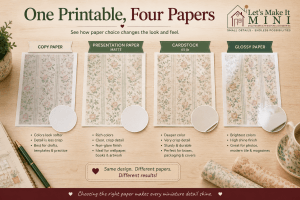
The same wallpaper can look surprisingly different depending on the paper you choose.
Books, Boxes & Tiny Details
One rainy afternoon I spent hours making miniature books for a library. By the end of the day there were tiny cookbooks, gardening books, travel guides, and children's stories scattered all over my worktable.
That's when I discovered something simple.
The pages looked great on ordinary copy paper, but switching the covers to lightweight cardstock suddenly made them look like real books.
The same idea works for countless miniature projects.
Think about everything that's made from paper in a real home:
- Cereal boxes
- Tea boxes
- Seed packets
- Greeting cards
- Shopping bags
- Gift boxes
- Recipe cards
- File folders
Most of these are perfect on 65 lb white cardstock. It folds neatly, stands on its own, and is sturdy without being difficult to work with.
It's one of those supplies you'll reach for again and again.
Plants, Artwork & Special Projects
Not every printable needs heavy paper.
Leaves, flowers, artwork, maps, calendars, framed pictures, and signs usually look wonderful on the same premium matte presentation paper you've already purchased for wallpaper.
That's one of the reasons I recommend it so often.
One package can handle dozens of different projects.
There are times when glossy paper makes sense—family photographs, magazine covers, or shiny advertisements, for example—but those are the exception rather than the rule.
For most miniatures, matte simply looks more realistic.

Different miniature projects call for different papers—but only a few versatile papers can handle almost everything.
What I Use at My Own Miniature Worktable
These are materials I use for my own miniature projects. I choose according to the finish I want, what’s available, and the price—you don’t need to buy everything to get started!
As an Amazon Associate I earn from qualifying purchases.
For wallpaper: I use matte presentation paper from Epson or Hammermill. Hammermill has become harder for me to find, so I use both brands with my Epson ET-8550.
See Epson Ultra Premium Presentation Paper Matte on Amazon (paid link)
For flooring, wall panels, and backing pieces: I use heavy comic-book backing board. I’ve printed, painted, and stained it for flooring, wall panels, and the backs of small furniture and cabinets. These boards measure 7 × 10.5 inches, so plan your printable layout accordingly. Check your printer’s media limits before printing directly onto board.
See HYARUAT 24-point backing boards on Amazon (paid link)
For small packaging and paper artwork: I use premium bright-white paper. In my experience, this better grade of paper holds fine printed details and shows less ink or glue bleed-through than everyday copy paper.
See HP Premium32 paper on Amazon (paid link)
For miniature textiles: I use inkjet-printable fusible fabric with 100% quilting cotton to make bedding, drapes, and pillows. I haven’t tried it for upholstery yet. Follow the product’s printing and fusing instructions.
See printable fabric sheets on Amazon (paid link)
For framed artwork and textured walls: I use printable cotton canvas. I’ve found it works well for both projects, adding a fabric texture to the finished surface.
See Koala printable cotton canvas on Amazon (paid link)
Start with the material that suits your next project, and print a small sample before committing to a full sheet.
Shopping Without Feeling Overwhelmed
The paper aisle has a remarkable way of making perfectly sensible adults question everything they thought they knew about paper. I've done it myself. Now I keep things simple.
Instead of comparing every package on the shelf, I ask one question.
What am I making this week?
- Wallpaper?
- Presentation paper.
- Gift boxes?
- Cardstock.
- Practice prints?
- Copy paper.
The project tells me what paper I need.
Not the other way around.

These five papers are enough to create almost every printable project you'll find on Let's Make It Mini.
A Few Tips I've Learned
Here are a few little habits that have saved me both time and paper.
- Print a small test before committing to a full sheet.
- Use Actual Size (100%) when printing miniature projects.
- Let ink dry completely before cutting.
- Replace hobby knife blades often—they're safer and give cleaner cuts.
- Store paper flat in a dry place.
Simple habits, but they make a big difference.
To make shopping even easier, I've created a free one-page Paper Quick Reference Guide that summarizes everything we've talked about.
Print it, tuck it into your craft folder, or keep a copy on your phone for your next trip to the office supply store.
Next month, when you're standing in the paper aisle, I hope you won't feel overwhelmed. Instead, I hope you'll look at those shelves and think, "I know exactly what I need for my next miniature project."
Final Thoughts
Miniature making has taught me that extraordinary little rooms are built from very ordinary materials.
- A sheet of paper.
- A little glue.
- A sharp hobby knife.
- A bit of imagination.
Don't wait until you own every paper on the shelf or have the perfect craft room.
Start with one good package of paper. Print something. Build something that makes you smile.
Because that's how every miniature maker begins—one tiny project at a time.
Happy makinig!
~ Deb Rogers, Founder
Let's Make It Mini


[…] with a test build. An attractive picture and a working printable are two separate achievements; our paper guide can help with the physical […]